
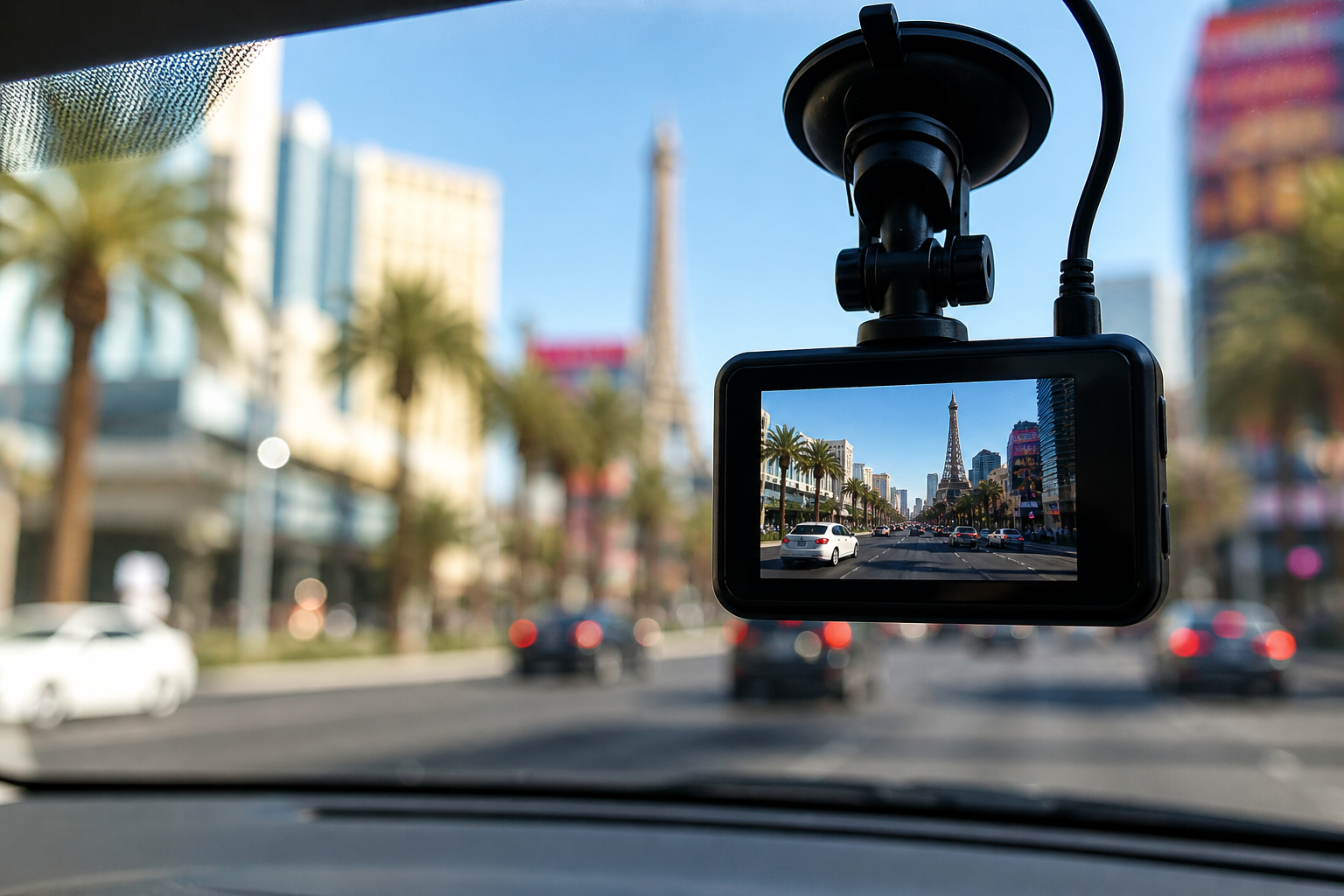
Dashcams have become one of the most valuable tools a driver can have. They capture accidents in real time, protect against fraudulent claims, and can be the deciding factor in a personal injury lawsuit. But before you mount a camera to your windshield and hit the Las Vegas Strip, there are a few Nevada-specific rules you need to understand. Here is everything you need to know about dashcam laws in Las Vegas.
Are Dashcams Legal in Las Vegas and Nevada?
Yes, dashcams are completely legal to use in Nevada. No state law prohibits drivers from recording video while operating a vehicle. Law enforcement agencies, rideshare drivers, and everyday commuters across Las Vegas use them routinely, and Nevada courts have accepted dashcam footage as evidence in both criminal and civil proceedings.
That said, legality comes with conditions. How and where you mount your dashcam, whether you record audio, and how you use the footage all carry their own rules under Nevada law.
Where Can I Legally Mount a Dashcam in Nevada?
This is where many Las Vegas drivers unknowingly run into trouble. Nevada law prohibits drivers from placing any object on the windshield that obstructs the driver’s clear view of the road. While the law does not specifically mention dashcams by name, a camera mounted in a way that blocks sight lines can result in a traffic citation.
Best practices for legal dashcam placement in Nevada:
- Mount the camera in the upper center portion of the windshield, tucked close to the rearview mirror, where it falls within the mirror’s existing blind spot.
- Alternatively, mount it on the dashboard itself, below the windshield line.
- Avoid placing the camera on the driver’s side, where it could obstruct peripheral vision.
- Keep all wiring tucked away so it does not hang across your field of view.
A small, properly positioned dashcam mounted near the rearview mirror is highly unlikely to result in any legal issue. The key is that the camera must not meaningfully obstruct your view of the road ahead.
Does Nevada Have Audio Recording Laws That Apply to Dashcams?
This is one of the most important and most overlooked aspects of dashcam use in Nevada. While video recording is straightforward, audio recording is governed by a separate and stricter set of rules.
Nevada is a one-party consent state when it comes to audio recording. This means that in a private conversation, only one person involved in the conversation is required to consent to the recording. When you are in your own vehicle, and your dashcam is recording, you are that consenting party, so recording conversations inside your car is generally lawful.
However, issues can arise in certain situations:
Rideshare and for-hire drivers — if you are a Lyft or Uber driver in Las Vegas using a dashcam that captures audio, passengers may have a reasonable expectation of privacy in some circumstances. While Nevada’s one-party consent rule technically allows you to record since you are a party to the conversation, best practice is to display a visible notice that dashcam recording is in use. Both Uber and Lyft permit dashcam use by drivers, but recommend informing passengers.
Recording outside your vehicle — if your dashcam captures audio of conversations happening outside your car, such as through an open window during an argument after an accident, the legal picture becomes more complex. Consult an attorney to determine if such recordings can be used as evidence.
Interstate travel — if you drive across the border from Nevada into California, the rules change immediately. California is a two-party consent state, meaning all parties must consent to an audio recording. If your dashcam is recording audio, and you cross into California without informing passengers or others being recorded, you could be violating California’s wiretapping law.
Can Dashcam Footage Be Used as Evidence in a Nevada Car Accident Case?
Absolutely — and it can be extraordinarily powerful. Nevada courts accept dashcam footage as evidence in both civil personal injury cases and criminal proceedings, provided the footage is authentic and properly preserved.
Dashcam video can establish:
- Fault and liability — showing exactly how an accident unfolded, who ran the red light, who was speeding, or who crossed the center line
- Impact severity — visual documentation of the force of a collision, which supports claims of serious injury
- Road and weather conditions — the state of the road, visibility, and traffic conditions at the exact moment of the crash
- The other driver’s behavior — erratic driving, distracted behavior, or signs of intoxication leading up to the impact
- Hit-and-run identification — capturing license plate numbers and vehicle descriptions when a driver flees the scene
At The Walsh Firm, Ltd., we have seen dashcam footage change the outcome of cases that might otherwise have come down to one driver’s word against another’s. If you have footage from an accident, preserve it immediately and share it with your attorney before doing anything else.
What Should I Do with Dashcam Footage After an Accident in Las Vegas?
Dashcam footage is only valuable if it is properly preserved and handled. Here is exactly what to do:
- Do not delete or overwrite the footage — most dashcams record on a loop, automatically overwriting older footage. As soon as an accident occurs, manually save or lock the relevant clip so it is not erased.
- Remove the memory card or download the footage to a secure location as soon as possible.
- Make multiple copies — save the footage to a USB drive, an external hard drive, and a secure cloud storage account.
- Do not edit or alter the footage in any way — even trimming irrelevant portions can raise authenticity questions in court.
- Share it with your attorney immediately — before sending it to any insurance company or posting it anywhere online, let your lawyer review it and advise on how to use it strategically.
- Note the timestamp settings on your dashcam — if the time or date displayed on the footage is incorrect, your attorney needs to know so it can be properly explained.
Can the Other Driver or Insurance Company Demand My Dashcam Footage?
Yes. If a lawsuit is filed, dashcam footage on your device may be subject to discovery, the legal process by which both sides can request evidence from the other. This means that if your dashcam captured footage that is unfavorable to your own case, the opposing party may be entitled to see it.
This is another reason why speaking with a spinal injury or personal injury lawyer in Las Vegas before sharing any footage is critical. Your attorney can review everything first and advise you on your legal obligations and options.
Conversely, if the other driver had a dashcam, your attorney could demand that footage through the discovery process as well, even if that driver is reluctant to share it.
Does Dashcam Footage Help or Hurt My Personal Injury Claim?
In most cases, dashcam footage helps significantly. The majority of accident disputes center on conflicting accounts of what happened. Objective video evidence cuts through he-said-she-said arguments and gives insurance companies and juries a clear picture of the truth.
That said, footage can cut both ways. If your dashcam captured you looking at your phone, driving aggressively, or failing to brake in time, that footage could be used to assign you a greater share of fault under Nevada’s comparative negligence rules, reducing your compensation accordingly.
The lesson is not to avoid dashcams, it is to drive as you always should, and to let an experienced personal injury lawyer in Las Vegas review all footage before it goes anywhere near an insurance company.
Are There Any Dashcam Rules Specific to Commercial Vehicles in Nevada?
Commercial vehicles operating in Nevada, including semi-trucks, delivery vehicles, and buses, are subject to federal and state regulations that often require event data recorders and, increasingly, forward-facing cameras. If you were injured by a commercial vehicle in Las Vegas, the trucking or delivery company may have dashcam or fleet camera footage of the accident.
This footage is extremely valuable, and companies know it. It is not uncommon for fleet operators to claim footage was overwritten or unavailable. A personal injury attorney can send an immediate spoliation letter, a formal legal notice demanding that all video evidence be preserved before it conveniently disappears.
What Are the Best Dashcams for Las Vegas Drivers?
While recommending specific brands falls outside legal advice, Las Vegas drivers should consider a few practical factors when choosing a dashcam:
- Heat tolerance — Las Vegas summers routinely push temperatures well above 100°F. Interior car temperatures can exceed 160°F. Choose a dashcam rated for extreme heat and consider removing the memory card on particularly hot days to prevent data corruption.
- Night vision capability — Las Vegas roads at night, particularly on the Strip and in surrounding areas, involve complex lighting conditions. A camera with strong low-light performance captures details that matter.
- GPS logging — a dashcam with built-in GPS records your speed and location alongside the video, adding a layer of objective data to any accident claim.
- Dual-channel recording — front and rear cameras provide more complete coverage, particularly important given the high rate of rear-end collisions on Las Vegas freeways.
How Can The Walsh Firm, Ltd. Help If You Have Been in an Accident?
Whether you have dashcam footage or not, if you have been injured in a car accident in Las Vegas due to someone else’s negligence, The Walsh Firm, Ltd. is here to help. Led by Robert J. Walsh, with over 35 years of Nevada legal experience and more than 10,000 personal injury cases handled, our firm will:
- Immediately act to preserve all available evidence, including dashcam footage, traffic cameras, and witness statements.
- Work with accident reconstruction experts to establish liability.
- Fight insurance companies that attempt to minimize your injuries or dispute the facts.
- Pursue the full compensation you are entitled to, including medical expenses, lost wages, pain and suffering, and more.
- Handle everything on a contingency fee basis — no fees unless we win.
Speak With a Personal Injury Lawyer in Las Vegas Today — Free Consultation
A dashcam can be one of your strongest allies after an accident. But the right legal representation is even more powerful. If you have been injured on Las Vegas roads, do not leave your recovery to chance.📞 Call The Walsh Firm, Ltd. at (702) 474-4660 or contact us online for your free consultation. We are ready to fight for you.